What You’ll Read
- Vacancies & Appointments: Washington Governor names Justice Mary Yu’s replacement on state supreme court; Utah Gov. Spencer Cox appoints an anti-abortion justice and considers expanding the court.
- New Jersey High Court Is Nation’s First To Ban Dubious “Shaken Baby Syndrome” Evidence—Will Other Junk Science Follow?
- Cases To Watch: Is Colorado’s Lifetime Sex Offense Registration “Punishment”?
- Cases To Watch: The MA Supreme Judicial Court Can Expand State Constitutional Rights To Ban Racial Profiling
- Dispatch From Oregon: Is this a dagger which I see before me, The handle towards my hand? No, it’s a steak knife.
- This month in “juicy, backstabbing drama between warring ideological factions” on state supreme courts
Vacancies & Appointments
- Washington Governor Bob Ferguson appointed career civil rights lawyer Colleen Melody to replace Justice Mary Yu on the state supreme court. Yu, who will retire on Dec. 31, has been a leading voice on strengthening state constitutional rights against extreme criminal punishments—authoring or joining opinions that, among other things, struck down the state’s death penalty and banned life without parole for children—while also pushing the court to question lifelong prison sentences for anyone. While Melody is a civil rights lawyer, she has worked exclusively for the government—both for the U.S. Department of Justice and the Washington Attorney General—leaving her views on governmental power in criminal contexts unclear.
- In Utah, Governor Spencer Cox appointed anti-abortion culture war zealot John Nielsen to the state supreme court—and says he may support a proposal to expand the court in order to create a majority more favorable to legislative Republicans. While the Utah Supreme Court is entirely GOP-appointed, it has been an independent check on certain issues, including by protecting abortion rights. Nielsen, meanwhile, once made the “originalist” argument that abortion is traditionally “something meriting the utmost condemnation available in our law and society: criminal charge and punishment.”
New Jersey High Court Is Nation’s First To Ban Dubious “Shaken Baby Syndrome” Evidence—Will Other Junk Science Follow?
One month after the Texas Court of Criminal Appeals invoked a “junk science” law to stop an execution in a case of alleged “shaken baby syndrome,” or “SBS,” the New Jersey Supreme Court became the nation’s first to ban evidence of the controversial diagnosis entirely. Biomechanical experts have long-criticized SBS as pseudoscience that wrongfully sends hundreds of parents and caregivers to prison every year for crimes that never happened. It is a diagnosis based not on medical examination or tests, but applied when doctors run out of other explanations. In State v. Nieves, which affirmed both trial and lower appellate court rulings, New Jersey’s high court held that evidence of SBS—typically an expert witness testifying that child abuse is the only possible explanation for a baby’s death—is too unreliable for criminal courtrooms. “The State has not met its burden,” the court explained, “because the research, studies, and testimony [it] presented … reflect a lack of general acceptance in the biomechanical community[.]”
But SBS is hardly the only questionable science that routinely sends people to prison. Bite-mark matches, blood-splatter analysis, handwriting comparisons, tire tread compressions, and other forms of commonly-dramatized evidence have little to no empirical support, according to the National Academy of Sciences’ National Research Council. Yet trial judges usher this evidence into courtrooms simply because other judges before them did the same thing—a phenomenon that Radley Balko calls “a jurisprudential version of the childhood game of Telephone.”
For MSNOW, law professor John Pfaff explains that Nieves is good news amid the growing “challenge that empirical evidence poses for a legal system that has very few practitioners—lawyers or judges alike—with scientific or statistical training[.]” Even when judges look to empirical evidence, in other words, they are often ill-equipped to understand it.
Still, state supreme courts are a promising path to reform. The Hawaii Supreme Court, for example, has relied on “extensive scientific literature” to limit police deceptions during, and require video recordings of, custodial interrogations. Likewise, the Connecticut Supreme Court restricted eyewitness identification testimony based on “near perfect scientific consensus,” and now retroactively applies new rules of criminal procedure that are based on scientific advances. Such responsiveness to scientific progress has implications beyond the admissibility of evidence. Excessive sentencing analysis has also turned on scientific consensus, with state high courts in Massachusetts, Michigan, Washington, and elsewhere citing psychology and neuroscience to restrict life prison terms that, such evidence shows, fail to serve any legitimate purpose. [State v. Nieves | MSNOW]
RELATED: It’s not just data and science. The Washington Supreme Court said that constitutional law must also account for “two [other] things the law has not always adequately understood: young people and social media.” In State v. Luna, decided on October 30, the court overturned a 16-year-old girl’s murder conviction because (citing her age) she did not sufficiently understand her rights to counsel and remain silent before speaking with police, and because the trial court wrongly admitted inflammatory TikTok videos while excluding other social media that could have helped the defense. [State v. Luna]
Cases To Watch: Is Colorado’s Lifetime Sex Offender Registration “Punishment”?
In 2021, in a case called People in Interest of T.B., the Colorado Supreme Court held that mandating lifetime sex offender registration for youth under 18 is “cruel and unusual” punishment that violates the federal 8th Amendment. To get there, the court first had to find that registration counts as “punishment” at all, instead of merely a “civil” or “regulatory” sanction to which constitutional limits on punishment do not apply. State prosecutors often invoke that distinction to shield draconian sanctions placed on people with sex offense convictions—including lifetime registration and indefinite incarceration—from constitutional review, especially as evidence mounts that such extreme measures, born of moral panic around sex crimes, do nothing to protect public safety or reduce crime.
Predictably, the issue is back before the Colorado Supreme Court, this time in a broader challenge that would apply to adults. The court heard oral argument in October in the case of a man who pleaded guilty to attempted sexual assault and distributing drugs to a minor. Despite no prior sex crimes on his record, the man is now a registered “Sexually Violent Predator” for life, with no mechanism to challenge the label. He argues that this designation, and all that comes with it, is unconstitutionally cruel and unusual.
At the very least, the same reasoning from People in Interest of T.B. should dictate that unchallengeable lifetime registration is punishment. Whether applied to children or adults, sex offense registries bear the hallmarks of criminal punishment: They are imposed after criminal convictions, publicly shame those who are on them, and, among other onerous restrictions and requirements, effectively limit where people can live and work.
At oral argument, at least some justices seemed to agree.
“No opportunity to get off the registry. Got to show up in person (four) times a year. There are fairly significant consequences here, and I question whether that matches to the non-punitive purpose,” said Justice Richard L. Gabriel, according to Colorado Politics. Still, as is so often the case, concerns over “too much justice” loomed large. After all, if registration is “punishment” in this context, what other constitutional rights might they violate? “I confess,” Justice Monica M. Márquez said, “being a little concerned about opening the floodgates.”
The case is People v. Beagle. More: Colorado Politics | ACLU Amicus brief
RELATED: Michigan Supreme Court holds in People v. Lymon (2024) that requiring someone without any sex-related convictions to register as a sex offender violates the state constitution’s ban on “cruel or unusual” punishment.
Cases To Watch: The Massachusetts Supreme Judicial Court Could Expand State Constitutional Rights To Ban Racial Profiling
In 1996, the U.S. Supreme Court held that the Fourth Amendment provides no protection against racial profiling in traffic stops. In Whren v. United States the Court said that, as far as the Fourth Amendment is concerned, police can stop and investigate anyone they choose, for whatever reason, so long as there is some traffic violation to justify the stop. That the violation is mere pretext is beside the point. The rule gave license to predatory policing and, unsurprisingly, exacerbated racial disparities in traffic enforcement.
On Wednesday, the Massachusetts Supreme Judicial Court will hear argument to reject this rule, and to hold that the state constitution’s search and seizure clause prohibits pretextual traffic stops—whether they are in reality motivated by race, unpopular political viewpoint, or any other discriminatory reason. “Police can find an ostensible traffic-related reason to stop any car on the road,” a brief from the New England Innocence Project and the Massachusetts Association of Criminal Defense Lawyers, among others, points out. “That reality has made pretext stops the modern-day general warrant,” and have granted police “arbitrary government power” that “overwhelming evidence demonstrates … is exercised in a racially discriminatory way[.]”
The Massachusetts high court would not be the first to use its own state constitution to protect people from arbitrary and discriminatory policing: The state supreme courts in Arkansas, New Mexico, and Washington have each held that—using language from the Arkansas opinion—“pretextual arrests … are unreasonable police conduct warranting application of the exclusionary rule.”
The case is Commonwealth v. Arias.
Dispatch From Oregon: Is this a dagger which I see before me, The handle towards my hand? No, it’s a steak knife. The Oregon Supreme Court held last week that a law prohibiting people on probation from possessing “weapons” does not encompass ordinary steak knives. Prosecutors argued that “weapons” means anything that could cause injury. But “[i]t is unlikely that the legislature intended for ‘weapons’ to mean literally anything capable of being used to inflict injury,” the court wrote. “The state’s interpretation would require us to hold that a probationer would be prohibited from keeping any number of objects in their home, including … baseball bats, kitchen knives of all varieties, and many kinds of cutlery, even plastic picnic cutlery.” [State v. Cortes | Courthouse News Service]
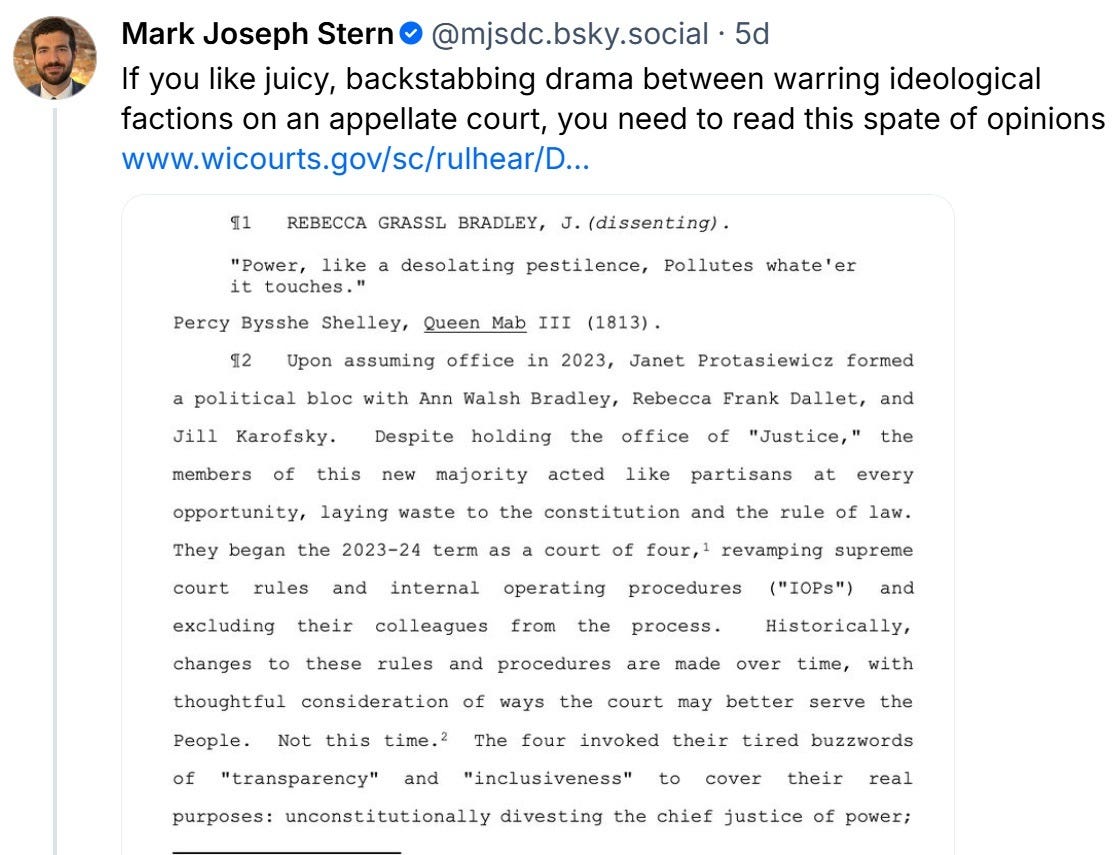
This month in “juicy, backstabbing drama between warring ideological factions” on state supreme courts. The Wisconsin Supreme Court has been the perennial favorite in this category, and it did not disappoint in November. Slate’s Mark Joseph Stern covers the latest deeply personal internecine battle—which stems from a relatively innocuous change in internal procedures—on BlueSky: