Over 30 years ago, in a case now infamous for all-but erasing federal 8th Amendment rights against excessive prison terms, Justice Anthony Kennedy wrote that “no sentence of imprisonment would be [unconstitutionally] disproportionate” for “the crime of felony murder without specific intent to kill.”
Not so in Pennsylvania.
In a groundbreaking opinion that signals a paradigm shift in how courts treat excessive punishment claims, the Pennsylvania Supreme Court today held that mandatory life without parole sentences for “felony murder” violate the state constitution.
Over 1,000 people in Pennsylvania are serving life terms with no chance of release for homicide convictions based solely on their role in some other crime — without any finding that they ever killed or intended to kill anyone. Convicted under the arcane “felony murder” rule, they may have been getaway drivers or lookouts for some other crime that went bad and led to death, and then punished like killers. Under Commonwealth v. Lee, they can now demand a new sentence based on their individual culpability and seek a meaningful chance for release.
The ruling also charts new territory in the trend of state courts expanding rights against the harshest criminal punishments. Unlike other recent rulings, Lee does not depend on the age of those who are sentenced. Instead it turns on the nature of the offense, and specifically the reduced culpability inherent to felony murder. In this way, the ruling does not merely expand the category of people entitled to existing rights—extending youth protections from age 17 to 20, for example—it carves out a new category altogether, and leaves a legal road map for other courts to follow.
***
First, some brief background on constitutional rights and the limits of criminal punishments.
The federal 8th Amendment and every state constitution prohibit excessive punishments. Yet in the annals of American constitutional law, judicial rulings that bar adult prison terms are few and far between (the U.S. Supreme Court has issued exactly one, and thereafter retrenched so deeply that it approved 50-years in prison for stealing video tapes from K-Mart). With some exceptions, constitutional limits on criminal punishments have been reserved for youth and capital cases, with the judicial axioms “death is different” and “youth is different” used to both expand and constrict rights—expanding rights through heightened judicial scrutiny of death sentences and life prison terms for children; constricting rights by withholding such scrutiny from everyone else.
It’s an artificial divide that never made sense. Telling courts to employ meaningful, evidence-based judicial review in some cases and a deferential rubber stamp in others puts the proverbial cart before the horse, conflating judicial outcomes with the legal rules used to reach them. If certain punishments are upheld as constitutional, it should be because they pass constitutional muster, not because constitutional concerns are ignored under a special deferential standard that all but tells courts to look the other way. As law professor Rachel Barkow has argued, “[t]here is nothing in the Constitution’s text or history that supports employing two different tests for excessiveness or applying the Eighth Amendment with ‘special force’ in some cases and not others. … The Court’s two-track approach to sentencing is legally and normatively untenable.”
Rather than correct course through their power to independently interpret their own state constitutions, most state supreme courts have reflexively followed this approach. The result has been the proliferation of cruel and needless life—or, more accurately, “death by incarceration”— prison terms unchecked by constitutional constraints.
Lee, though, is a dramatic exception.
***
Section 13 of Pennsylvania’s state constitution prohibits “cruel punishments.” To apply this in Lee, the state supreme court first found that Section 13 is both independent from and broader than the federal 8th Amendment:
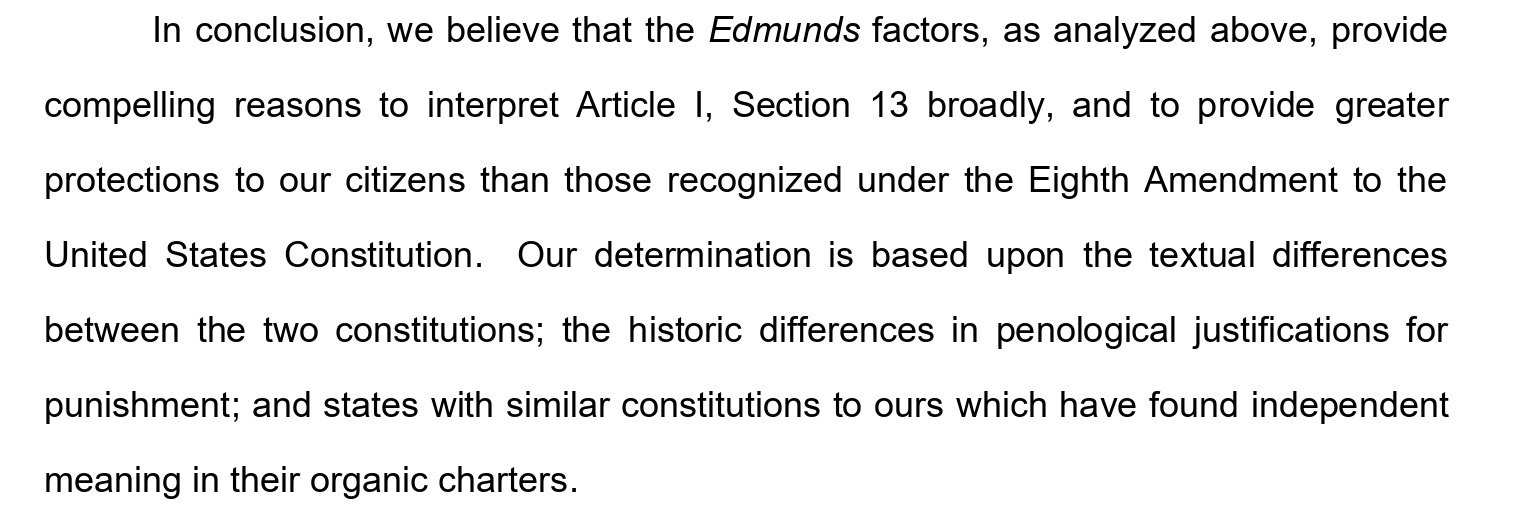
In addition to the key textual distinction — a ban on all “cruel” punishments instead of those that are both “cruel and unusual” — the court relied heavily on historical analysis, observing that the Commonwealth’s founders embraced a “distinctly Pennsylvanian” view of punishment based on Enlightenment ideals of punishing only to promote deterrence and reformation:
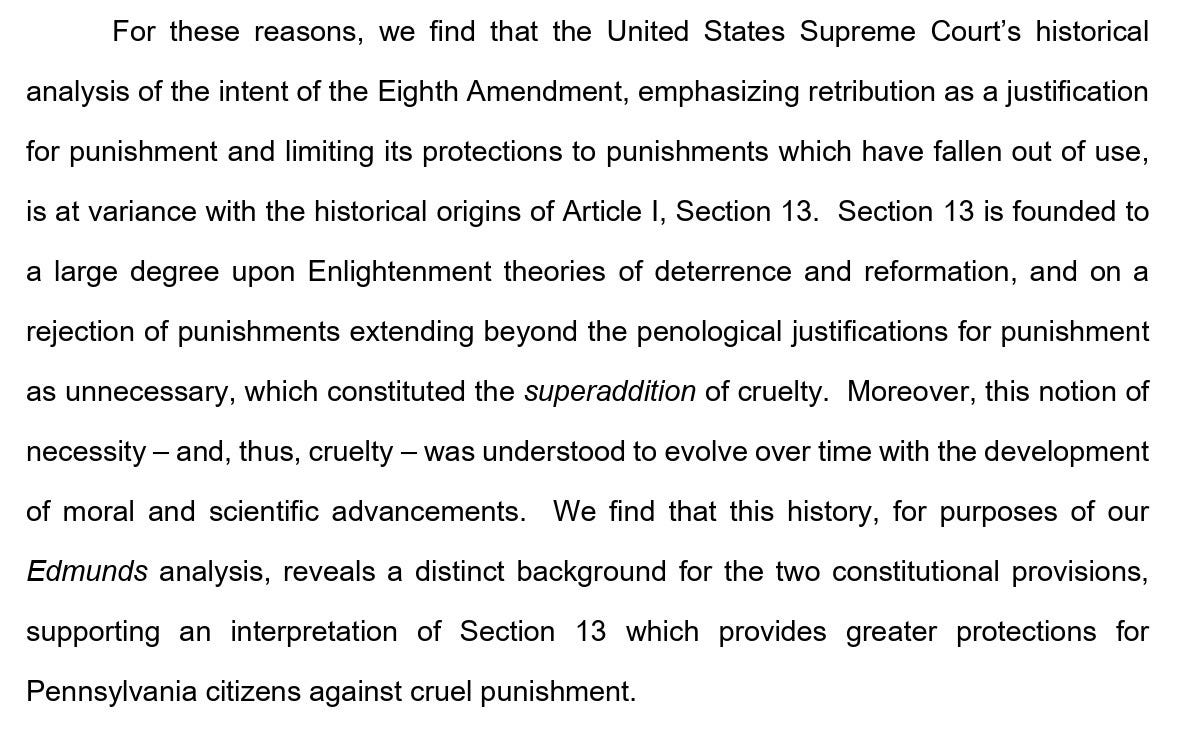
Having established that Section 13 goes further than federal protections, the court turned to the question of whether mandatory LWOP for felony murder is “cruel.” And here’s where it provides a roadmap for state court practitioners and judges around the country. Gone is the “two track” approach that has cabined 8th Amendment protections to capital cases and age-based claims. Rather, the court applied heightened review to the category of people with felony murder convictions, scrutinizing whether mandatory LWOP for this group comports with individual culpability and serves any legitimate penological purpose of punishment — just as the U.S. Supreme Court did to protect children from life prison terms.
The court explained that its analysis would mirror the “framework” in “Eighth Amendment jurisprudence regarding juveniles” because “the principles announced therein are equally applicable to an analysis under Section 13.”
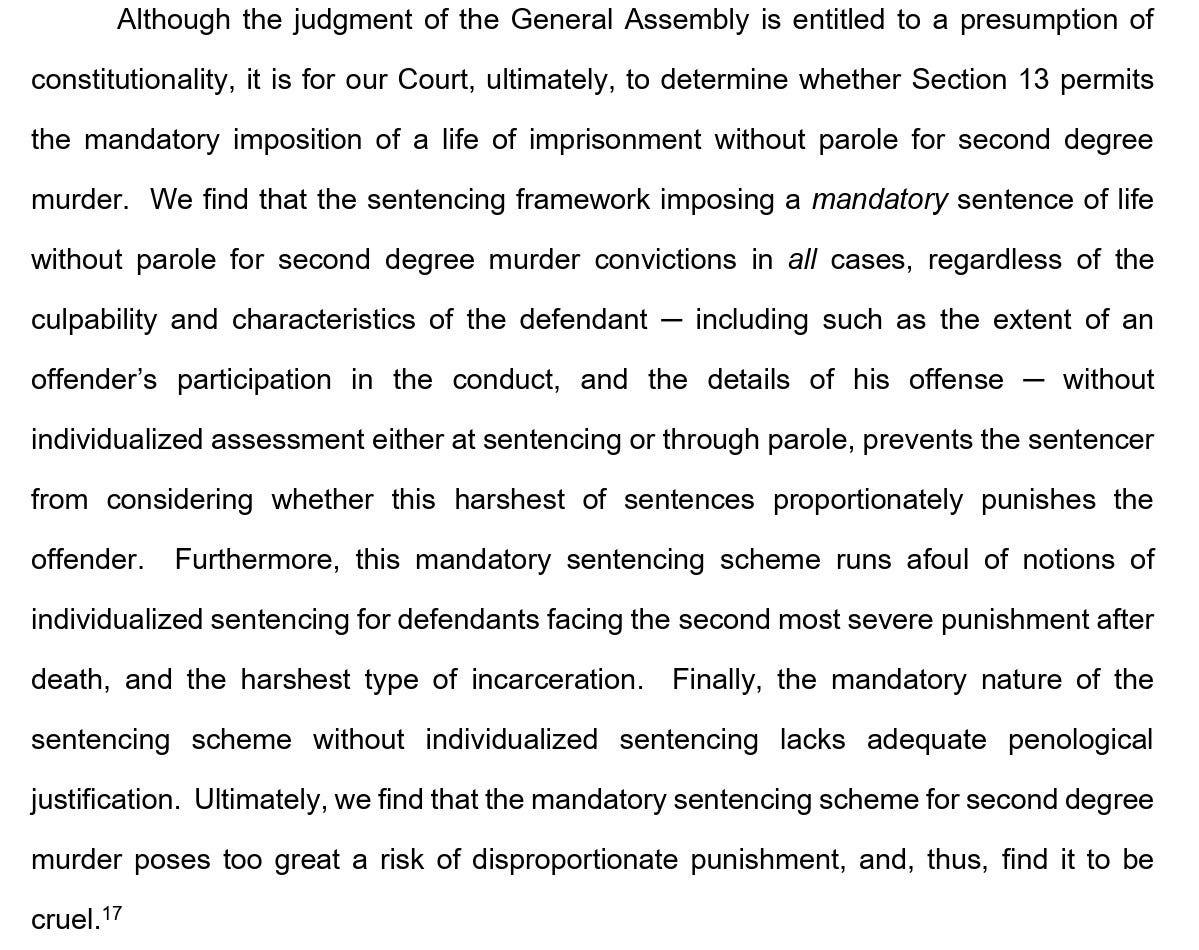
Applying that framework here, the court reasoned that “one who did not kill another or intend to kill another during the commission of a felony is less morally responsible and less deserving of one of the most severe punishments — mandatory life imprisonment without the possibility of parole — than the actual murderer.” Yet a mandatory punishment scheme “fails to assess culpability regarding the intent to kill” and therefore, in combination with the extreme severity of LWOP, “poses a great risk of disproportionate punishment.”
Next, the court explained that criminal punishments must be proportionate not just to individual culpability, but also to some legitimate state purpose. This is a crucial inquiry that provides teeth to judicial review of criminal punishments; it allows courts to ensure that legislatures do not impose arbitrary punishments and requires prosecutors, in defending a challenged sentence, to establish a sufficient nexus between the punishment and the appropriate purpose it was ostensibly imposed to serve. The court summarized the question this way:
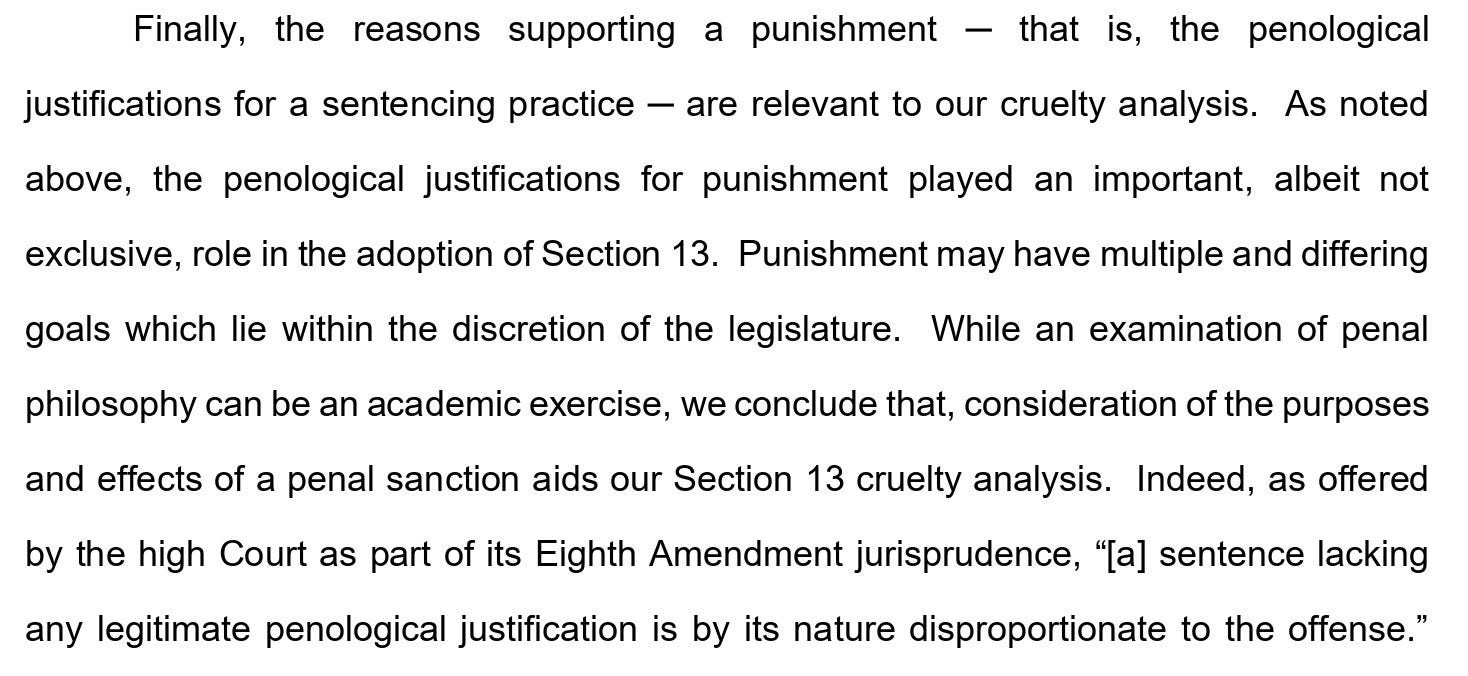
Here, the court found that sentencing people to die in prison without any assessment of their individual culpability, and without any finding that they killed or intended to kill anyone — that is, to treat unwitting partners the same as someone who pulled a trigger — wholly fails to serve the general purposes of rehabilitation, deterrence, retribution, or incapacitating people who pose a danger to the public. If anything, the court explained, the Commonwealth’s punishment scheme undermines these goals, and is therefore cruel.
With this finding the court concluded:
In Pennsylvania, this ruling could be a major step toward decarceration. Around the country, it could finally spark more rigorous judicial review of the excessive and draconian punishment practices that have fueled mass incarceration for decades.